A rain-shadow archipelago in the top corner of Washington — drier and sunnier than Seattle, built for island-hopping, orca-watching and sea kayaking through protected channels. But the whole trip turns on one thing: the Anacortes ferry, and whether you've dealt with its summer vehicle reservations — or sidestepped them entirely by going car-free. This issue is about planning the islands the way they actually work, not the way a postcard implies.
The rest of this journal is evergreen; this box is not. Everything below is dated to the day we checked it, and the most perishable items here — the ferry reservation window, the Discover Pass price, the legal whale-approach distances — change faster than any printed guide. Trust the live sources, not our date stamp.
The San Juans sit in the rain shadow of the Olympics and Vancouver Island, which makes them noticeably drier and sunnier than the mainland — roughly half the rain of Seattle. They're small, low-traffic and cycling-friendly, and a trip is built around the ferry, the whales, the kayaking and one real mountain. But every good plan here starts and ends at the Anacortes tollbooth, so we lead with it.
Not every sailing stops at every island, and some run express to Friday Harbor. Read the schedule for your exact departure, not the route in general.
Once you're across, a San Juans trip is really five things layered together: the ferry itself; whale and orca watching, from boats and from shore; sea kayaking the protected channels; low-key hiking and the one real climb up Mount Constitution; and tide pools and beachcombing. It's a summer-forward region — peak wildlife, peak ferry demand and park reservations all concentrate May through September.
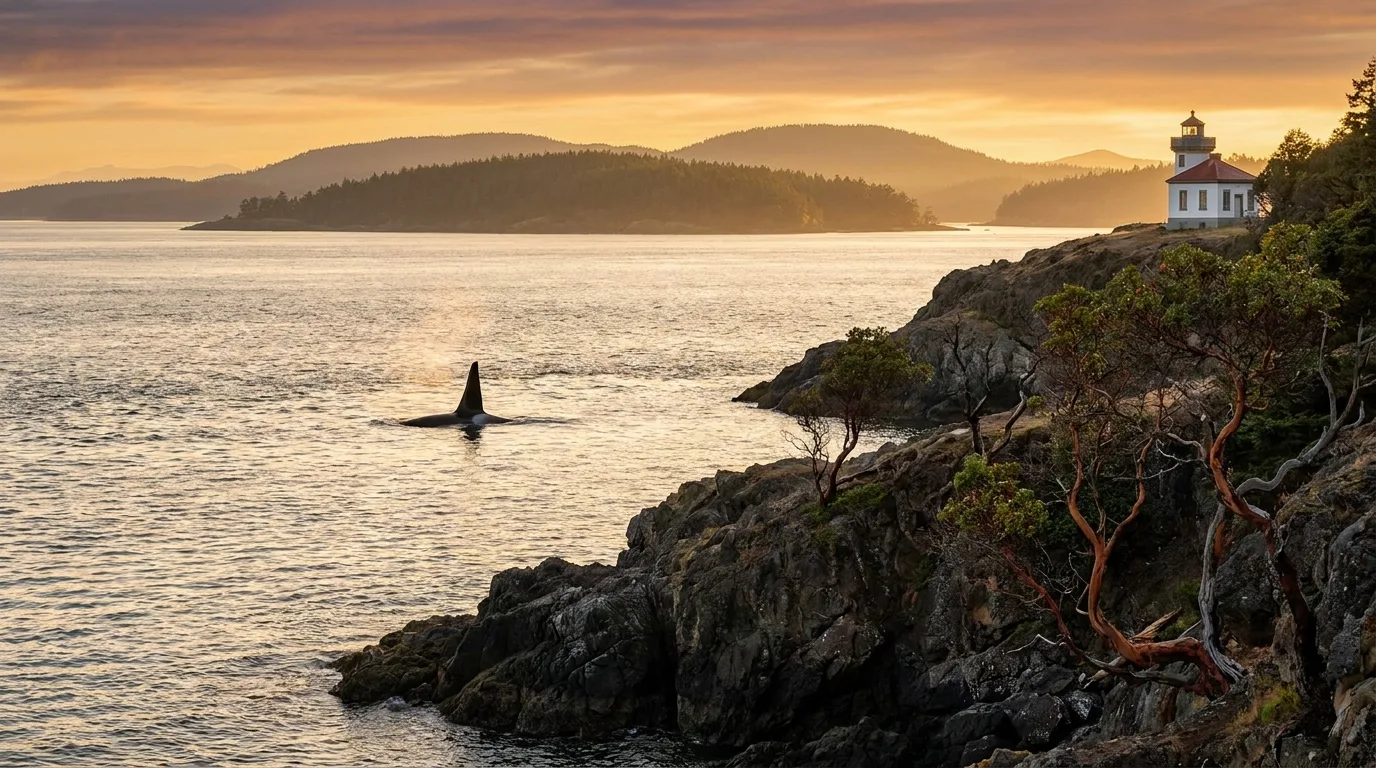
San Juan Island is the busy one — the county seat at Friday Harbor, the ferry hub, and the departure point for most whale-watch and kayak trips. It's also where you watch orcas from dry land at Lime Kiln, walk the prairies and forts of the Pig War park, and stand under a lighthouse where the current rips past the point.
On the west side of the island over Haro Strait, and widely called one of the best places on earth to watch whales from shore. The steep drop-off just offshore pulls foragers in close: the endangered Southern Resident orca pods (J, K, L) frequent the strait May through September, timed to the salmon runs, with transient (Bigg's) orcas, minke whales, porpoises and seals also passing. There's a 1919 lighthouse, an interpretive center and picnic sites. Open 8 a.m. to dusk year-round; Discover Pass required to park.
The national historical park commemorates the 1859–72 "Pig War" boundary standoff between the US and Britain — a confrontation whose only casualty was a pig. Two units: American Camp on the south peninsula (open prairie, bald eagles, foxes, and South Beach — the longest public beach on the island) and English Camp on Garrison Bay to the northwest (a formal garden, a blockhouse, forest trails and a short climb up Young Hill). Free; grounds open year-round, visitor contact stations seasonal.

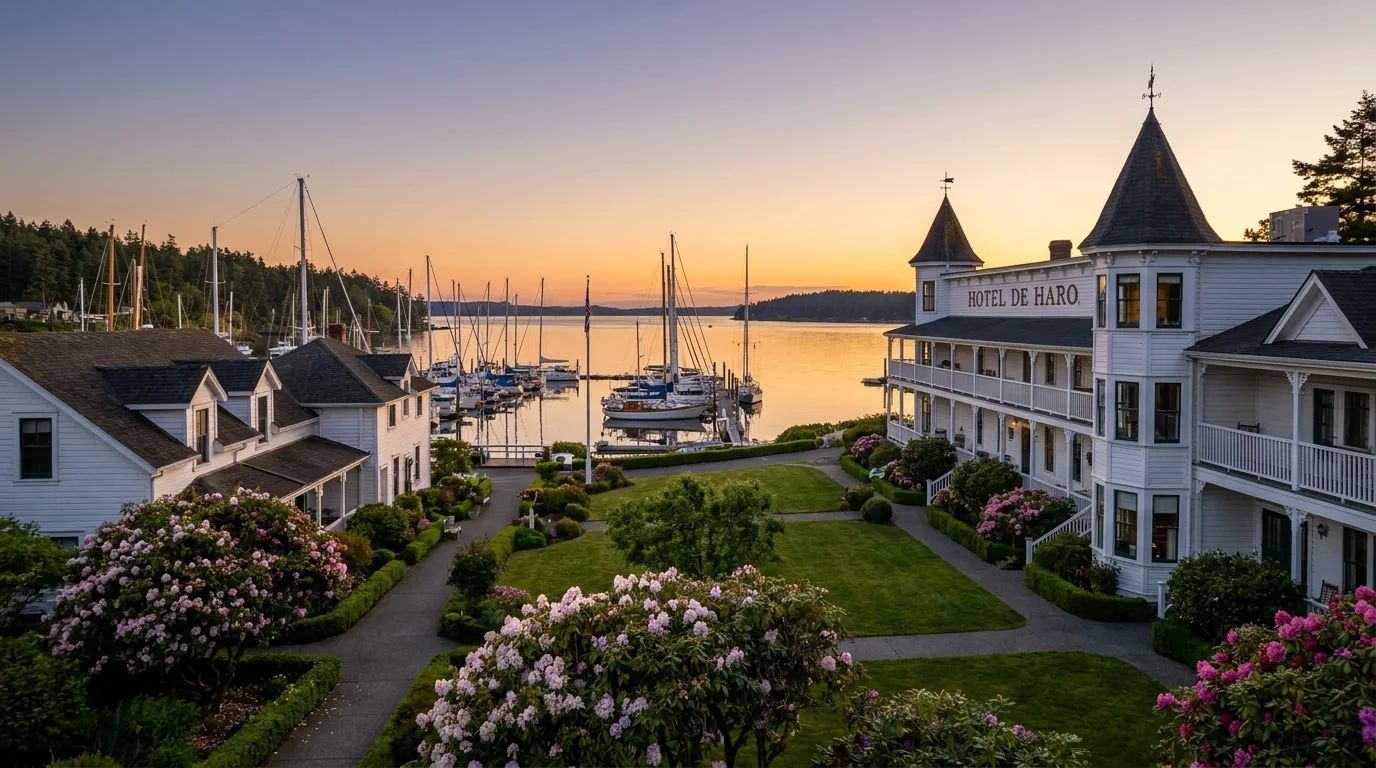
Roche Harbor, on the sheltered northwest corner, is a historic lime-company town turned resort village — the restored Hotel de Haro (1886), a marina, gardens, and the quirky Afterglow Vista mausoleum nearby. It's a common kayak-launch and whale-watch departure hub; the village is publicly walkable, the resort is a private business.
Cattle Point, at the island's southern tip beside American Camp, is a windswept 1935 concrete lighthouse over San Juan Channel — big raptor and marine-mammal watching, and strong offshore currents (exterior viewing only). Between them, San Juan County Park at Smallpox Bay on the west side doubles as a shore whale-watching spot and a prime kayak put-in.
🔴 Cattle Point's offshore currents are no place to swim or paddle casually — see the cold-water and tidal-current caution in §00.
Orcas is the largest and hilliest of the ferry-served islands, shaped like a saddlebag around East Sound, with Eastsound village at its head. Its centrepiece is Moran State Park — five lakes, four campgrounds, a waterfall, and the highest point in the archipelago, which you can drive or climb.
At roughly 5,424 acres, Moran is the largest park in the San Juans — five lakes and four campgrounds. Mount Constitution tops out at 734 m / 2,409 ft, the highest point in the islands, with a stone summit tower and a view that reaches the North Cascades and Vancouver Island. You can drive to the top or earn it on foot or bike via the park trails; the summit road can be gated in winter ice or snow. Discover Pass required.
Cascade Lake is the swimmable, family lake at the park's heart — non-motorized boating (canoe, kayak and paddleboard rentals in summer), swimming, and a roughly 2.7-mile lakeside loop. It anchors Moran's main campgrounds.
Cascade Falls is a roughly 40 ft cataract, one of the tallest waterfalls in the islands, reached by a short quarter-mile forested walk from a marked lot on Mount Constitution Road. It flows best in winter and early summer and can slow to a trickle by late summer — so if the falls are your reason to go, time it early.
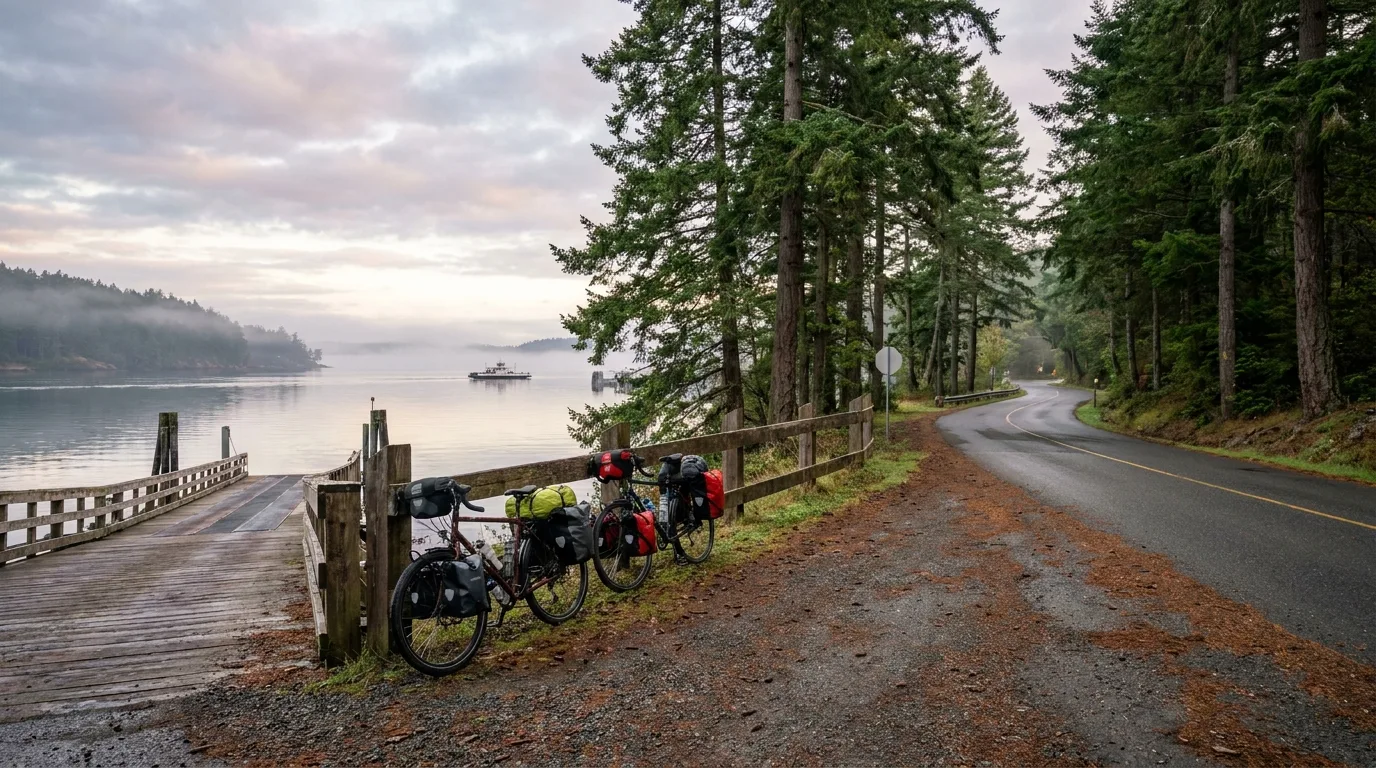
Lopez is the first stop off the ferry and the gentlest of the three big islands — rolling farm roads, a wave-from-every-car reputation, and the flattest riding in the San Juans. It's the island to cycle, to camp near the landing, and to walk out to a headland where seals haul out below churning current.
A 138-acre marine park on the northeast shore, built around a rare sand spit that encloses a saltwater lagoon. It's known for crabbing and clamming, has about 2 miles of trail, and its campground (§07) mixes standard sites with hiker/biker and boat/kayak sites. Discover Pass required for day-use. A natural first or last stop, close to the ferry landing.
On the island's southwest corner, a roughly 1-mile round-trip forest walk opens onto a rocky headland over San Juan Channel with near-certain harbor seals — plus sea lions, otters and eagles — and hard-churning tidal currents below. No facilities. It's an easy, high-payoff walk, but the caution is real: the current here is powerful and the rock is slick (§00).
The water is the reason many people come. Protected channels make the San Juans a classic sea-kayaking destination, and the resident and transient orcas make it one of the best whale-watching regions in North America. Both are best done with people who know the currents and the rules — so this section names real, established outfitters, and states plainly where the line is around the whales.
Guided day trips and multi-day island-camping expeditions run from across the region. On San Juan Island: San Juan Kayak Expeditions and Sea Quest Kayak Tours (naturalist-led, often biologist guides) out of Friday Harbor, Outdoor Odysseys, and San Juan Island Outfitters at Roche Harbor. On Orcas: Shearwater Adventures in Eastsound (running since 1982; sunset and bioluminescent night paddles). From Anacortes, no ferry needed: Anacortes Kayak Tours (Skyline Marina) and Blue Otter Outfitters.
Listed from the outfitters' own public sites; details and seasons change — book direct.
Boat tours depart Friday Harbor, Roche Harbor, Orcas and Anacortes. From Friday Harbor: Maya's Legacy Whale Watching (small-group, never more than 15 passengers), San Juan Safaris, and Western Prince (the longest-operating whale-watch company in the islands). From Orcas / Eastsound and Anacortes: Outer Island Expeditions. From Anacortes: Island Adventures. Peak season is May–September; expect Southern Resident and transient orcas plus humpbacks, minke, porpoise, seals and sea lions.
Beyond the four ferry islands is a second archipelago you reach only by boat or kayak — the marine parks strung along the Cascadia Marine Trail. They're the quietest camping in the San Juans, and the most committing: no ferry, no store, and water only in season. Jones Island is the classic.
A small state-park island with about 24 primitive campsites, part of the Cascadia Marine Trail — the water route that links paddle-in campsites through Puget Sound and the San Juans. Some sites are reservable, others first-come. There is no ferry service: the nearest launch is Deer Harbor on Orcas. Drinking water is typically only on roughly mid-May through September, so plan to carry your own outside that window — and treat it as carry-in, carry-out primitive camping.
You get there under your own power or with an outfitter. Several of the kayak companies in §05 run multi-day island-camping expeditions that stage exactly this kind of trip, which is the sensible way in if you don't have your own sea kayak and the skills to read the channels. The currents here are strong and cold (§00), so a crossing to a marine park is not a beginner's solo outing.
The payoff is real: these are the emptiest, darkest, most wildlife-rich camps in the islands, with none of the ferry-town bustle. If you can paddle competently or go guided, a marine-trail night is the trip's quiet highlight.
There's no national-forest sprawl here — camping in the San Juans means state parks, county parks and a handful of private resorts, spread thin across the islands and booked hard in summer. None of the state parks have hookups. Reserve early, carry a Discover Pass, and know which island each bed is on before you commit to a ferry.
Four campgrounds around Cascade Lake, roughly 124 standard sites plus 6 hiker/biker sites — the largest camping in the islands. Reservable Memorial Day to Labor Day; first-come October to March. No hookups. Discover Pass required.
⚠️ Nightly fee cited around $27 peak / $20 off-season — treat as approximate and verify current rates at booking. Site counts and season windows should be reconfirmed with Washington State Parks.
Spencer Spit State Park (Lopez): 37 standard sites plus hiker/biker and boat/kayak sites on the sand spit, campground mainly March–October, no hookups, Discover Pass. Odlin County Park (Lopez): a 30-site waterfront county campground about a mile from the ferry landing, camping mainly April–October, seasonal water, no hookups — the ideal car-free first night.
⚠️ Current nightly fees not captured on a primary page — verify at booking.
| Campground | Island | Type | Sites | Hookups | Notes |
|---|---|---|---|---|---|
| Moran State Park | Orcas | State | ~124 + hiker/biker | None | Four campgrounds at Cascade Lake. Reservable May–Sep, first-come Oct–Mar. Discover Pass. Fee ~$27/$20 ⚠️ |
| Spencer Spit SP | Lopez | State | 37 + hiker/biker + kayak | None | Sand-spit marine park, mainly Mar–Oct. Discover Pass. Reserve in summer |
| Obstruction Pass SP | Orcas | State | Small ⚠️ | None | Walk-in / boat-in shoreline sites, ~0.5-mi trail. Carry-in water. Mostly first-come |
| Jones Island Marine SP | Marine park | State | ~24 | None | Boat/kayak-in only — no ferry. Cascadia Marine Trail. Water ~mid-May–Sep (§06) |
| Odlin County Park | Lopez | County | 30 | None | ~1 mi from Lopez landing. Mainly Apr–Oct, seasonal water. Great car-free base |
| San Juan County Park | San Juan | County | Compact ⚠️ | None | Smallpox Bay, west side. Kayak launch & shore whale-watching. Reserve in summer |
| Shaw Island County Park | Shaw | County | 11 | None | Indian Cove. Reservable Apr 1–Oct 31, first-come Nov–Mar. No commercial services on Shaw |
| Lakedale Resort | San Juan | Private | ~30 tent + 5 RV | Some (RV) | Roche Harbor Rd. The only RV hookup sites on San Juan Island; also cabins & glamping ⚠️ |
| West Beach Resort | Orcas | Private | Tent + RV ⚠️ | Some (30-amp) | Sunny west side since 1938. RV sites w/ 30-amp power & water, cabins, kayak/whale access ⚠️ |
| Doe Bay Resort | Orcas | Private | Drive-in ⚠️ | None | East side near Olga. Drive-in tent/campervan, cabins, yurts, soaking tubs ⚠️ |
| Lopez Farm Cottages | Lopez | Private | ~8 | None | ~10 min from Lopez landing. Walk-in tent + glamping; adults-oriented ⚠️ |
⚠️ Site counts, seasons and every nightly fee should be reconfirmed at booking — several were not on a primary page we could load, and none are invented here. All state parks require a Discover Pass for day-use parking. Only the private resorts offer any hookups; no state or county park in the islands has them.
The single best planning decision in the San Juans is whether to bring a car at all. Skip it, and the summer reservation stress evaporates — because foot and bike passengers never need a slot. Here's the car-free playbook, and the honest case for when a vehicle is still worth it.
Rental operators listed from their own public sites; confirm seasons and availability direct.
A vehicle makes sense if you're hauling an RV or a lot of camp kit, covering hilly Orcas (the Mount Constitution road is a real climb), travelling with kids or mobility needs, or island-hopping several islands with gear in tow. If that's you, the rules are simple and firm: book your vehicle reservation the moment the window opens (about two months out), watch for the two-weeks and two-days release waves if the first is full, and check in at the Anacortes tollbooth at least 30 minutes early or lose the slot to standby.
Everything above, condensed into a print-ready PDF built for the day pack and the ferry queue — for an archipelago where the whole trip turns on a boat reservation, the water runs cold and fast, and the whales have the right of way. The Anacortes ferry system decoded, the car-free playbook, land-based orca watching at Lime Kiln, the Pig War forts, Mount Constitution and Cascade Falls, cycling and Shark Reef on Lopez, the real kayak and whale-watch outfitters, the paddle-in marine camps, and every state, county and private campground — with the Discover Pass, cold-water and give-whales-space cautions in plain sight.
Every Trekkr Trail Journal is built like this one: custom logistics, honest trail beta, the camping and access detail, kit lists and the local knowledge that turns a good trip into the one your crew talks about for years — including, always, a plain list of what we could not confirm. New destinations drop all season long, from the BC corridors to the Oregon Cascades to the Salish Sea.
Unlock the Trail Journal Library