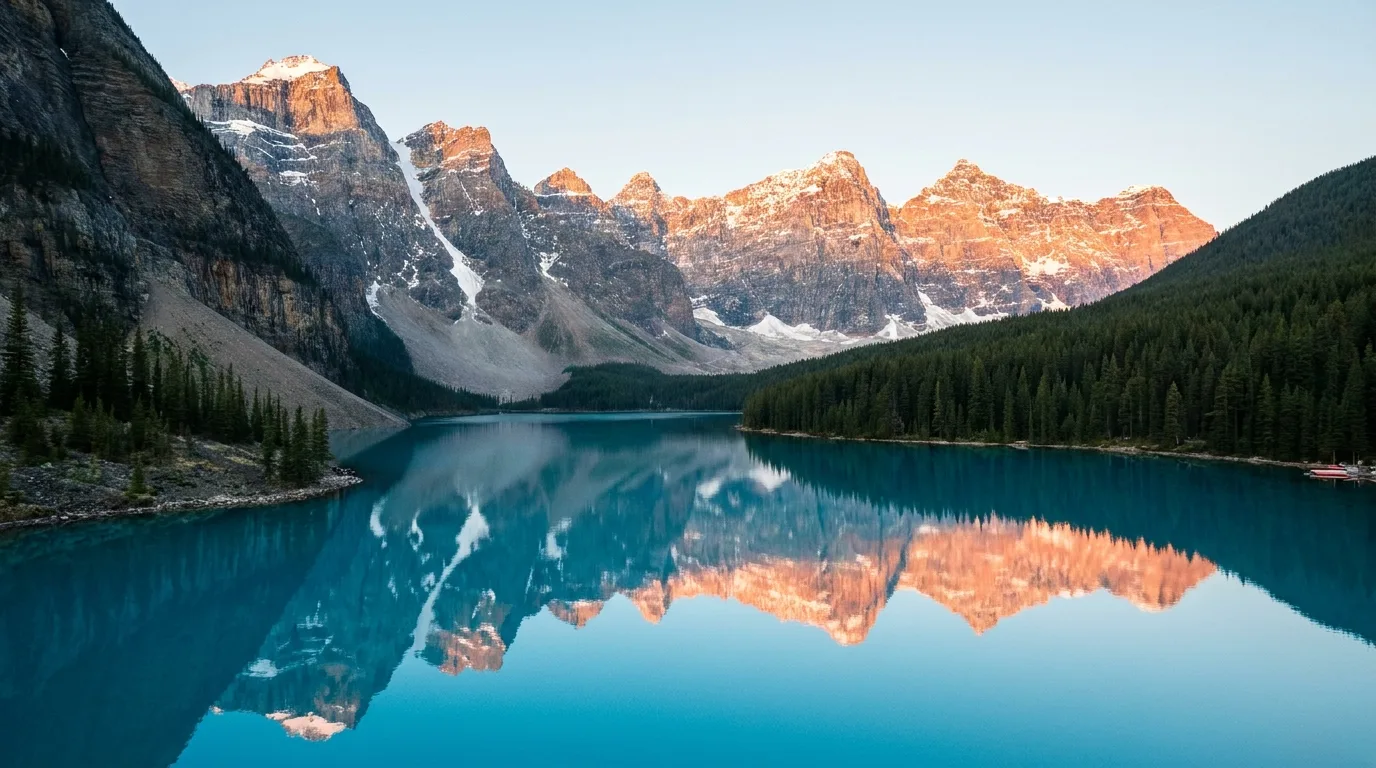
Moraine Lake and the Valley of the Ten Peaks at sunrise, turquoise glacier-fed water below jagged snow-dusted peaks, seen from the Rockpile viewpoint, Banff National Park
Trekkr Trail Journal · No. 026 · Banff National Park

Banff National ParkLake Louise, Moraine Lake & the Bow Valley — The Complete Field Guide

Banff is Canada's first national park (1885) and its busiest, and Moraine Lake and Lake Louise are the two most-photographed bodies of water in the country. That fame is the problem — and the reason for the one fact that breaks trips: you cannot drive your own vehicle to Moraine Lake. The road has been closed to personal vehicles year-round since 2023, unchanged for 2026. This issue is about beating the crowds instead of fighting them — the shuttle, the seat drop, the alpine start, and the Bow Valley corridor read lake by lake.

Alberta · Canada Banff · Lake Louise Moraine Lake — shuttle only Bow Valley Parkway
Est. 1885Canada's first — and busiest — national park
Shuttle-onlyMoraine Lake Rd closed to cars year-round
Jun 19–Sep 7Canada Strong Pass — free admission, 2026
1,383→2,600 mTownsite to the high alpine passes
Conditions verified 19 July 2026 · This is a reservation-and-shuttle park · This block goes stale — the links don't

The whole trip turns on the shuttle and the seat drop — and both reset every season

The rest of this journal is evergreen; this box is not. Banff's signature access rules — the Moraine Lake vehicle ban, the Parks Canada shuttle calendar, the Bow Valley Parkway restrictions, the free-admission window and the bear closures — are dated, and the exact dates and rules move year to year. Everything below is dated to the day we checked it. Trust the live Parks Canada sources, not our date stamp.

  • You cannot drive to Moraine Lake — year-round, unchanged for 2026Moraine Lake Road is closed to personal vehicles year-round. Access is by Parks Canada shuttle, licensed commercial tour, registered Moraine Lake Lodge guest, or bicycle only. Time of day makes no difference. One unofficial report says even accessibility placards no longer grant vehicle access — verify that on the Parks Canada accessibility page before relying on it (§02).
  • Book the shuttle — and set an alarm for the 2-day-out seat drop2026 shuttle reservations opened April 15 at 8 a.m. MDT. Only 40% of seats released that day; the other 60% release at 8 a.m. MDT exactly two days before each departure. That drop is how last-minute visitors get on. Lakeshore-Louise shuttle runs May 15–Oct 12; Moraine shuttle June 1–Oct 12, including 4 a.m./5 a.m. "Alpine Start" departures. Non-refundable fee $3.50 online / $5.50 by phone (§03, §06).
  • Canada Strong Pass — free admission Jun 19–Sep 7, 2026 (but not free lakes)Park admission is free June 19 – September 7, 2026, plus 25% off Parks Canada camping over the same window. It's not a physical pass — just show up. The fine print: free entry covers park and historic-site admission only. Parking, shuttles, gondolas, tours and fire permits still cost full price (§07).
  • Lake Louise lots fill before dawn — ~75% of cars turned awayYou can still drive to the Lake Louise lakeshore lot and pay to park (May–Oct), but Parks Canada says roughly 75% of vehicles are turned away once the lots fill — often before 6 a.m. in peak summer. Park at the free Lake Louise Ski Resort Park & Ride (1 Whitehorn Road) and ride the shuttle instead (§02).
  • Bow Valley Parkway (Hwy 1A) — eastern 17 km has 2026 restrictionsThe eastern 17 km (Fireside to Johnston Canyon) has a nighttime wildlife closure Mar 1 – Jun 25 (no travel 8 p.m.–8 a.m.) and a vehicle-free daytime cycling window (8 a.m.–8 p.m.) Apr 30 – Jun 25 and again Sep 1 – Oct 6, 2026. To reach Johnston Canyon during restrictions: cycle in, ride Roam Route 9, or approach from the Castle Junction end (§03, §07).
  • Group-of-4 bear rule & wildfire smoke are live seasonal variablesOn trails beyond Moraine's lakeshore (Larch Valley, Sentinel Pass, Consolation Lakes, Eiffel Lake) a mandatory minimum group size of 4 is in force during berry season (~July–September). Separately, Rockies wildfire smoke is an annual July–September risk — no specific 2026 Banff closure was confirmed at press, so treat it as a live risk. Check the AQHI and Parks Canada bulletins day-of (§05).
Live sources · Parks Canada — Visiting Lake Louise & Moraine Lake (shuttle & vehicle ban) · Parks Canada — live trail conditions · Parks Canada — seasonal closures · Canada Strong Pass · reservation.pc.gc.ca — shuttle & camping
In an emergency, 911 (Banff dispatch). Reservations through the Parks Canada Reservation Service, 1-877-737-3783. This box was true at press and will not stay true — the sources above are the truth on the day you travel.
01 / THE HOOK

The most-photographed water in Canada — and the traffic that broke it

Banff has been Canada's first national park since 1885, and Moraine Lake and Lake Louise are the two most-photographed lakes in the country. That fame is exactly the problem: for years the Moraine Lake parking lot was a pre-dawn demolition derby — cars circling, idling, parking illegally on the shoulder, a genuine safety and ecological mess. Parks Canada's answer was blunt. In 2023 they closed the road to private vehicles entirely. For 2026 the ban stands, and Lake Louise's own lots still turn most cars away.

The Rockpile viewpoint above Moraine Lake, intense turquoise glacial water ringed by the ten sharp peaks of the Wenkchemna range, morning light, Banff National Park
Moraine Lake from the Rockpile. A trivial 15–20 minute walk to one of the most famous views on Earth — but you have to hold a shuttle reservation just to stand here. The turquoise comes from glacial rock flour suspended in the meltwater.

Book, don't fight

Don't circle for parking that isn't there. Book the shuttle — and specifically the 60% seat release at 8 a.m. MDT two days before your date. That drop is the real chance at a good time slot.

Do the Alpine Start

The 4 a.m. / 5 a.m. Moraine shuttle puts you at the lake for sunrise and onto Larch Valley or Sentinel Pass before the crowds — and before the routine afternoon storms.

Sleep close, go shoulder

A Tunnel Mountain or Two Jack site plus an early bus beats a 5 a.m. drive from Canmore. And late June and late September (larch gold) deliver the scenery with a fraction of the July–August crush.

The way to think about the region — one valley, two towns, one basecamp choice Banff is really a single valley with two highways running its length, plus a handful of dead-end roads climbing to the famous lakes. You base out of either the Banff townsite (services, hospital, gear, the Tunnel Mountain and Two Jack campgrounds) or the Lake Louise hamlet (closer to the marquee lakes and the last fuel before the Icefields Parkway). The corridor (§02) tells you which roads move fast and which reward a slow drive; the lakes and their hikes (§03) are the payoff — reached by shuttle, not by your own bumper. Get the access right and the trip works.
02 / THE CORRIDOR

One valley, two highways, and the roads that dead-end at the lakes

Think of Banff as a single spine. Two parallel roads run the ~57 km between Banff townsite and Lake Louise; a scenic parkway peels north toward Jasper; and short spur roads climb to the marquee lakes — one of which you can no longer drive. Read the spine right and the daily commute stops being a fight.

                       N  (toward Jasper · Icefields Pkwy Hwy 93)
                       |
   Bow Lake · Mosquito Ck · Waterfowl Lks   <- ICEFIELDS PARKWAY (Hwy 93)
                       |
   [LAKE LOUISE] ----+---- Moraine Lake Rd  (SHUTTLE / BIKE ONLY) --> Moraine Lake
        |    \
        |     \___ Lake Louise Lakeshore Rd  (paid parking · fills ~75%)
        |
        |  TRANS-CANADA HWY 1  (fenced · twinned · fast — the commute road)
        |
        | ~ - - BOW VALLEY PARKWAY / Hwy 1A  (slow · scenic · wildlife) - - ~
        |          | Johnston Canyon |   | Castle Junction |
        |
   [BANFF TOWNSITE] --- Tunnel Mtn Rd (campgrounds) · Minnewanka Loop (Two Jack)
                       |
                       S  (toward Canmore · Calgary)
Fast through-route (Hwy 1) Slow scenic road (Hwy 1A) Shuttle/bike-only spur (Moraine) Icefields Parkway (Hwy 93)
The Icefields Parkway with Bow Lake, glassy turquoise water below Crowfoot Glacier and Bow Peak, forested shoreline, Banff National Park
The Icefields Parkway (Hwy 93). The northern arm of the corridor runs 230+ km to Jasper with only Saskatchewan River Crossing for services — Bow Lake, Mosquito Creek and Waterfowl Lakes are strung along it. Fill up in Lake Louise before you commit to it.
🔴 The two roads between Banff and Lake Louise are not interchangeable Trans-Canada Highway 1 is the fast, fenced, wildlife-overpass corridor — ~57 km / 35 min, and your daily commute road. The Bow Valley Parkway (Highway 1A) is the old road: slower, the best wildlife viewing in the park, and home to Johnston Canyon — but its eastern 17 km carries seasonal and time-of-day vehicle restrictions in 2026 (nighttime wildlife closure Mar 1–Jun 25; vehicle-free cycling window Apr 30–Jun 25 and Sep 1–Oct 6). Check §03 before you route down it.

Moraine Lake Road — shuttle, bike or bus

Closed to personal vehicles year-round. Exceptions are Parks Canada shuttles, licensed commercial operators, registered Moraine Lake Lodge guests, and cyclists. Biking up is a real if steep ~12 km option. One unofficial report says accessibility placards no longer grant vehicle access — verify on the Parks Canada accessibility page ⚠️.

No private cars, any hourBike · shuttle · commercial only

The Park & Ride — where the day actually starts

The Parks Canada Park & Ride sits at the Lake Louise Ski Resort, 1 Whitehorn Road — free parking for shuttle-ticket holders, accessible roughly 6 a.m.–8 p.m. There is no park-wide timed-entry gate in Banff; the shuttle reservation itself is the access-control mechanism for the two lakes (§03).

Free with a shuttle ticketNo park-wide timed entry
03 / THE DAY HIKES

Teahouses, larch valleys and a pass or two

This is the payoff. From a 15-minute stroll to the Moraine Rockpile up to all-day passes at 2,600 m, the day hikes here are the reason the shuttle exists. Difficulty is subjective and times assume an average fit hiker with stops. Distances and gains blend Parks Canada with AllTrails and blog figures and can disagree 10–20% — treat them as planning estimates and read the live trail-conditions page the morning you hike.

Lake Louise, turquoise glacial water leading to Victoria Glacier and the peaks at the head of the valley, forested shoreline, Banff National Park
Lake Louise & Victoria Glacier. The lakeshore is the trailhead for the two classic teahouse hikes — Lake Agnes and the Plain of Six Glaciers — and the Highline that links them. Go at opening; the crowds here are relentless by mid-morning.
🔴 Two rules that decide these hikes before you lace up First, Moraine-area trails require a shuttle reservation just to reach the trailhead — Larch Valley, Sentinel Pass, Consolation Lakes and the Rockpile all start from a lake you can't drive to. Second, on trails beyond the Moraine lakeshore a mandatory minimum group size of 4 applies in berry season (~July–September); solo and pair hikers can be turned back, and non-compliance tops out at a $25,000 fine (§05). Snow lingers on the high passes commonly into mid/late July — carry microspikes if you go early.
HikeTrailheadDistance (return)GainTimeThe one caution that matters
Lake Agnes TeahouseLake Louise lakeshore~7 km~400–495 m2.5–3 h · Moderate Teahouse is cash / small bills only, no card — and go at opening; the crowds are relentless.
Plain of Six Glaciers TeahouseLake Louise lakeshore~11–14 km~365–585 m4–6 h · Moderate Rockfall / avalanche runout near the glacier; upper trail holds snow into July.
Lake Agnes + Plain of Six (Highline loop)Lake Louise lakeshore~14.5–20+ kmup to ~1,000 m6–8 h · Hard An all-day effort — start early, carry water, respect afternoon storms.
Big Beehive (add-on to Lake Agnes)Lake Louise lakeshore~10–11 km~520 m4–5 h · Moderate Exposed switchbacks above Lake Agnes; loose gravel on the descent.
Moraine Lake RockpileMoraine Lake (shuttle)~0.8 km~24 m15–20 min · Easy Trivial hike — but you need a shuttle reservation just to be here.
Larch Valley → Sentinel PassMoraine Lake (shuttle)~11.6 km~725–800 m4–6 h · Hard Mandatory group of 4 (~Jul–Sep bear rule); snow cornice on the pass into late July.
Consolation LakesMoraine Lake (shuttle)~6 km~65 m2 h · Easy/Mod Same group-of-4 bear rule applies beyond the Moraine lakeshore.
Johnston Canyon (Lower + Upper Falls)Bow Valley Pkwy (1A)~5.4 km~120 m1.5–2 h · Easy Catwalks jam by mid-morning; road access restricted (§02) — take Roam Route 9.
Johnston Canyon → Ink PotsBow Valley Pkwy (1A)~11–12 km~215–330 m ⚠️4–4.5 h · Moderate Beyond the falls it's real trail — mud/snow into early summer; sources disagree on gain.
Sunshine Meadows (gondola)Sunshine Village (gondola)3–10 km (loops)varies2–5 h · Easy–Mod You must ride the gondola (~$70+GST adult ⚠️ unofficial); summer season ~Jul 6–Sep 20, 2026.
Healy PassSunshine parking (Healy Ck)~18 km~655 m6–8 h · Hard Long day; snow lingers at the pass into July; classic larch hike in late Sept.
C-Level CirqueUpper Bankhead (Minnewanka Loop)~7.8–8 km~455 m3–4 h · Moderate Old mine shafts near the start — do not enter; snow patches into July.
Tunnel Mountain SummitBanff townsite (St. Julien Rd)~4.5–4.8 km~260 m1.5–2 h · Easy/Mod The in-town leg-stretch; icy/greasy after rain, otherwise the park's safest classic.

⚠️ Distances and gains blend Parks Canada with AllTrails/blog figures and disagree 10–20% between sources; where they conflict we show a range and defer to Parks Canada. The Sunshine gondola fare and the Johnston Canyon → Ink Pots gain are flagged unofficial. Late-July snow holdouts (average year): Sentinel Pass, upper Plain of Six Glaciers, Healy Pass, Big Beehive shoulders, C-Level cirque bowl. Eiffel Lake has appeared as CLOSED on some recent trackers — verify on the live Parks Canada trail-conditions page.

The signature big day · Alpine Start recommendedLarch Valley → Sentinel Pass

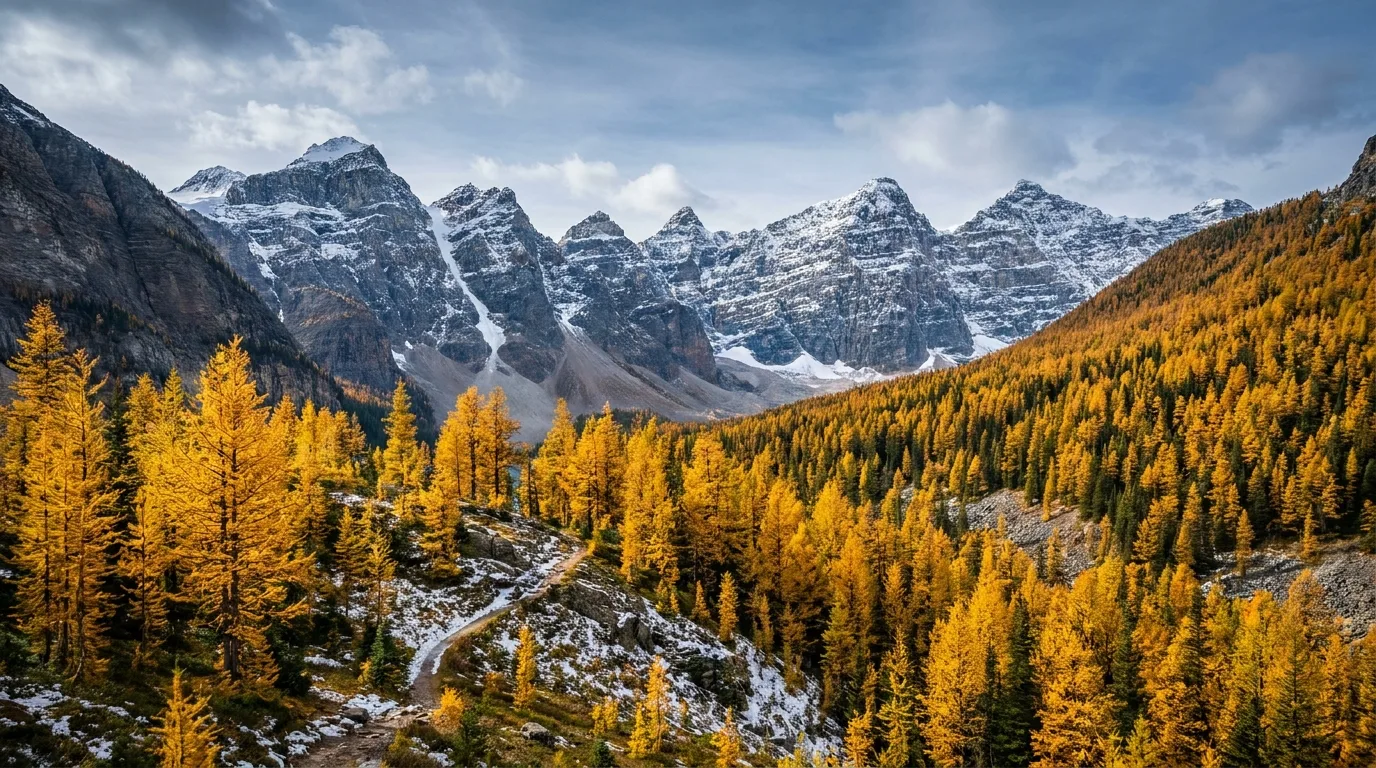
From the Moraine lakeshore the trail switchbacks up into Larch Valley — a bowl of alpine larch under the Ten Peaks that turns solid gold the last two weeks of September — then climbs to Sentinel Pass at the valley's head, one of the highest maintained trail passes in the park. Roughly 11.6 km / ~725–800 m gain, an all-day 4–6 hours. Take the 4 a.m. or 5 a.m. shuttle and you'll be at the pass before the crowds and the afternoon storms.

Mandatory group of 4 in berry season (~July–September) — solo or pair hikers turned back, $25,000 max fine. Snow cornice on the pass commonly lingers into late July. Shuttle reservation required just to reach the trailhead.

Group-of-4 zone (~Jul–Sep)Larch gold ~late SeptShuttle-access trailhead
~11.6 km return · ~725–800 m gain
4–6 hr · alpine, snow into late July
Larch Valley in autumn, golden alpine larch trees on the slopes below the sharp snow-dusted Ten Peaks, the trail climbing toward Sentinel Pass, Banff National Park
Larch Valley in larch season. For roughly two weeks in late September the alpine larches turn gold beneath the Wenkchemna peaks — the most sought-after hike window in Banff, and the reason the group-of-4 trailheads see queues even at dawn.
Lake Agnes and its historic log teahouse below a rocky cirque, a small alpine lake reached by trail above Lake Louise, Banff National Park

The teahouse classics — Lake Agnes & Plain of Six

Lake Agnes (~7 km, ~400–495 m, 2.5–3 h) climbs to a historic log teahouse on a cirque lake above Lake Louise — the teahouse is cash / small-bills only, no card. Plain of Six Glaciers (~11–14 km, 4–6 h) traces the far shore toward the Victoria Glacier and its own teahouse, with rockfall and avalanche runout near the ice and snow into July.

Link them on the Highline loop (~14.5–20+ km, up to ~1,000 m, 6–8 h) for a full day, or add the Big Beehive above Lake Agnes for exposed switchbacks and a big-view finish. All start at the busy Lake Louise lakeshore — go at opening.

Teahouse: cash onlyGlacier rockfall zone
The Plain of Six Glaciers trail traversing a moraine ridge above Lake Louise toward the icefall of the Victoria Glacier, glaciated peaks above a narrow path, Banff National Park
The Plain of Six Glaciers. The trail traces the far shore of Lake Louise and climbs a moraine toward the Victoria Glacier's icefall and its own teahouse — rockfall and avalanche runout near the ice, and snow lingering into July.
Steel catwalks bolted into the limestone walls of Johnston Canyon above emerald rushing water and a waterfall, Banff National Park

Johnston Canyon & the Ink Pots

Johnston Canyon (Lower + Upper Falls, ~5.4 km, ~120 m, 1.5–2 h) is the family classic — steel catwalks bolted into a limestone slot canyon. 🔴 The catch is access: the catwalks jam by mid-morning and the Bow Valley Parkway carries seasonal vehicle restrictions (§02), so take Roam Route 9, cycle in, or approach from Castle Junction.

Push past the falls to the Ink Pots (~11–12 km, 4–4.5 h) — cold mineral springs in a meadow. Beyond the falls it's real trail with mud and snow into early summer, and sources disagree sharply on the elevation gain.

Roam Route 9 to the trailheadCatwalks jam mid-morning
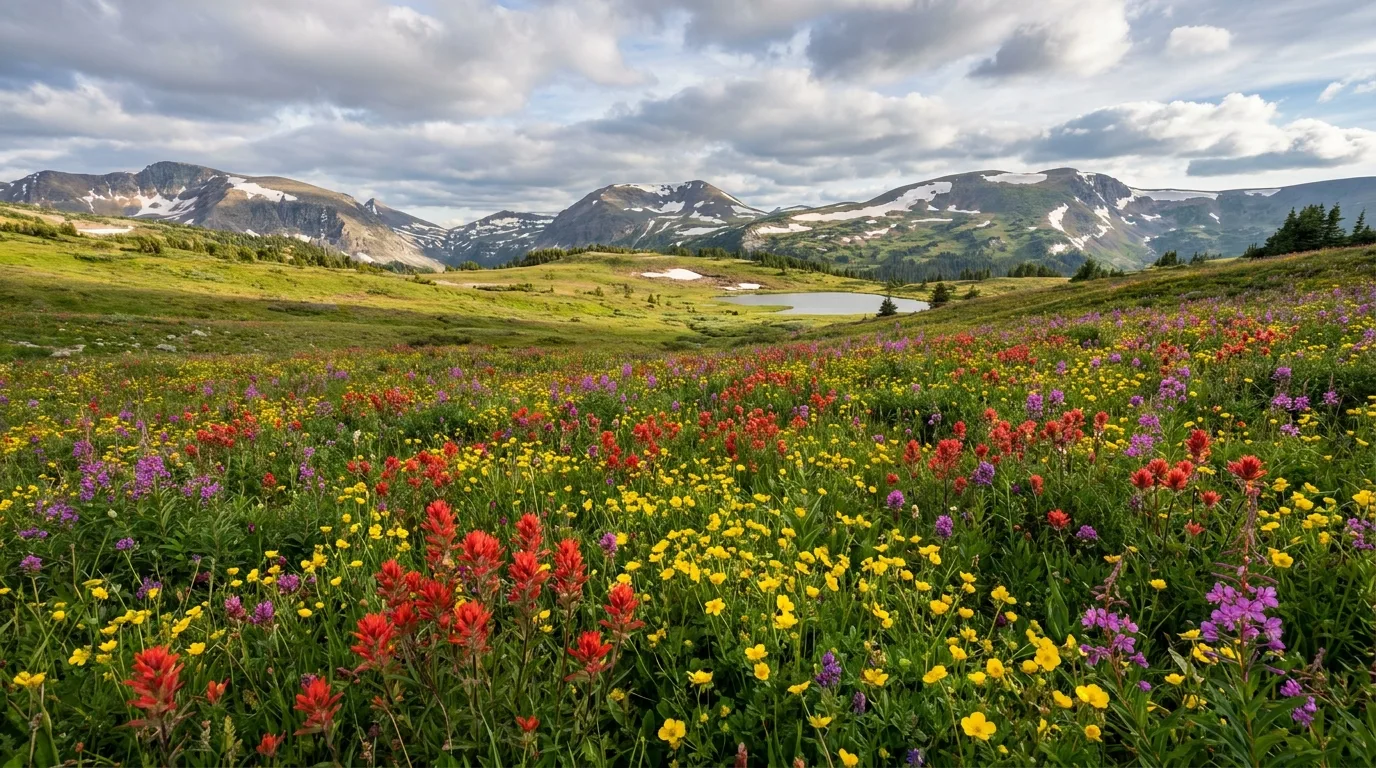
Sunshine Meadows in summer, rolling alpine meadows carpeted with wildflowers below Cascade peaks straddling the Continental Divide, Banff National Park

Sunshine Meadows & Healy Pass — the gondola country

Sunshine Meadows is a rolling alpine wildflower plateau on the Continental Divide, reached by riding the gondola (~$70+GST adult ⚠️ unofficial) up from the Sunshine Village base; the summer season runs roughly Jul 6 – Sep 20, 2026. Loop options run 3–10 km, mostly easy to moderate.

From the same base, Healy Pass (~18 km, ~655 m, 6–8 h) is a long hard day up Healy Creek — snow lingers at the pass into July, and it's a classic larch hike in late September.

Gondola-access · summer ~Jul 6–Sep 20Healy Pass: long alpine day
04 / THE CAMPING STRATEGY

Front-country beds, and the bear rules that sort them

Every Banff front-country campground is run by Parks Canada, and season reservations opened January 13, 2026. Two things shape your choice: the campgrounds cluster around Tunnel Mountain and Two Jack near the townsite, Lake Louise near the marquee lakes, and a string of primitive sites up the Icefields Parkway — and bear activity dictates which rigs go where. Remember the Canada Strong Pass knocks 25% off camping fees June 19–Sep 7, 2026.

Two Jack Lake at golden hour, a lakeside campsite among spruce with Mount Rundle reflected in still water, Banff National Park
Two Jack Lakeside. A small, fast-booking lakeside campground on the Lake Minnewanka Loop with Mount Rundle across the water — showers, no electrical, and a season that runs roughly late May to early October. The scenery-to-site ratio here is the best in the front country.
CampgroundSeason 2026SitesReserve?Services / water2026 fee (nightly)
Tunnel Mountain Village IMay 15 – Oct 5~618YesWater, flush toilets, showers; no electrical$34.00
Tunnel Mountain Village IIYear-round~209YesFull: elec/water/sewer, showersElec $40.00 / full $47.25
Tunnel Mountain Trailer CourtMay 7 – Oct 5~322YesFull hookups (water/sewer/elec)Full $47.25
Two Jack MainJun 18 – Sep 7~380YesWater, flush toilets; no showers, no elec$26.75 (equipped up to $86.50)
Two Jack LakesideMay 21 – Oct 5~74Yes (books fast)Water, toilets, showers; no elec$34.00
Johnston CanyonMay 21 – Sep 21~132YesWater, flush toilets, showers$34.00
Lake Louise Hard-sidedYear-round~189YesFull: elec/water, showers; hard-sided units onlyElec $40.00
Lake Louise Soft-sided (Tent)May 29 – Sep 23~206YesWater, showers; inside electric bear fence$34.00
Castle MountainJun 18 – Sep 20~42YesWater, toilets only$26.75
Protection MountainJun 18 – Sep 14~72YesWater, toilets only; limited cell$26.75
Waterfowl Lakes (Icefields Pkwy)Jun 18 – Sep 6~110First-comeWater, flush toilets; sani-dump$26.75
Mosquito Creek (Icefields Pkwy)Jun 11 – Oct 12~38First-comePrimitive: pit toilets, no potable listed$22.00
Rampart Creek (Icefields Pkwy)May 28 – Sep 20~51YesPrimitive$22.00
Silverhorn Creek (Icefields Pkwy)May 28 – Sep 27~45YesPrimitive$22.00

⚠️ Fees are from the official Parks Canada fees page; site counts and season dates are from the Parks Canada camping page (some counts are Parks Canada totals split across loops). Fire permits are extra: Banff area $12.00/day, Lake Louise & Icefields Parkway $17.00/day. Reserve at reservation.pc.gc.ca or 1-877-737-3783. Confirm dates before you rely on them.

The Lake Louise hard-sided / soft-sided split

At Lake Louise, all soft-sided units — tents, tent-trailers and RVs with soft pop-outs — must camp in the soft-sided campground, which is ringed by an electric fence, because of persistent seasonal bear activity. Only fully hard-sided units may use the hard-sided section. Don't book a tent site expecting to park next to a friend's Class-A — by law they're in different loops.

Soft rigs → electric-fenced loopHard-sided section separate

When everything's full

The in-park pressure valve is the Lake Louise overflow area (~$13.50) when the main campground fills. The first-come Icefields sites — Waterfowl Lakes and Mosquito Creek — hold no reservations, so arrive early. Beyond the boundary, provincial and Kananaskis campgrounds toward Canmore and commercial RV parks absorb overflow — but Kananaskis needs its own Conservation Pass (Alberta Parks), separate from your national-park pass ⚠️.

Overflow ~$13.50First-come: Waterfowl, Mosquito Ck
The one move that makes or breaks a summer trip Season reservations opened January 13, 2026, 8 a.m. MT — the marquee campgrounds (Two Jack Lakeside especially) book out fast. Reserve the day you can through reservation.pc.gc.ca or 1-877-737-3783, and keep a Tunnel Mountain site or the Lake Louise overflow as the fallback. Remember the Canada Strong Pass takes 25% off camping fees June 19–Sep 7, 2026 — but parking, shuttles and fire permits are still full price.
05 / BEARS & SAFETY

Why the food-storage law and the group-of-4 rule are not theatre

Banff's safety story is mostly about bears, weather and cold-water-cold-air exhaustion — and the rules here have real teeth because they're written in real incidents. None of it should stop you; all of it should shape how you camp and when you climb.

A grizzly bear foraging on a distant buffaloberry-covered slope in golden late-summer light, wide landscape framing, Banff National Park, no people
Buffaloberry season. From roughly July to September grizzlies feed hard on berries along valley slopes — which is exactly when the Moraine-area group-of-4 rule and periodic Minnewanka closures kick in. Store food like it's the law, because it is.

Food storage is mandatory — Apr 1 to Nov 15

Bear-resistant food storage is mandatory April 1 – November 15 across Banff, Yoho, Kootenay and Jasper under the Bare Campsite program. All food, coolers, dishes, toiletries and garbage must be locked in a hard vehicle or bear locker when not in use. In the backcountry, cook, eat and store at least 50 m from the tent and downwind.

Mandatory Apr 1 – Nov 15Lock food · cook 50 m off

The group-of-4 rule (Moraine area)

On trails beyond Moraine's lakeshore — Larch Valley, Sentinel Pass, Consolation Lakes, Eiffel Lake — Parks Canada imposes a mandatory minimum group size of 4 in berry season (~early July–September). The rule dates to 1999 after serious bear encounters; the minimum dropped from 6 to 4 in 2007. Non-compliance is an offence — maximum fine $25,000 — and solo or pair hikers can be turned back at the trailhead. The Lake Minnewanka / Stewart Canyon corridor sees recurring seasonal restrictions too.

Min. group of 4 (~Jul–Sep)$25,000 max fine
🔴 The incident that explains the rules On September 29, 2023, a fatal grizzly attack in the Red Deer River valley (backcountry northeast of Lake Louise) killed Doug Inglis and Jenny Gusse, both 62, and their dog in their tent. Parks Canada's necropsy found an older (est. 25+ year) non-lactating female grizzly in poor condition — bad teeth, low body fat. It was Banff's first bear-caused human fatality in decades. The historical basis for the group-of-4 rule is older: over 1998–2005, five bear attacks at two Banff locations (Allenby Pass near Bryant Creek; Aylmer Pass near Minnewanka) all involved people alone or in small groups who surprised female grizzlies with cubs during berry season. This is why food storage and group travel are not bureaucratic theatre. [2023 details media-sourced, citing Parks Canada.]
Weather, altitude & water Banff townsite sits ~1,383 m; the Moraine and Lake Louise trailheads ~1,880 m; the passes reach 2,300–2,600 m. Afternoon thunderstorms are routine in July — summit early and be below treeline by early afternoon, and know that snow can fall any month in the alpine. Altitude is modest, but thin air, sun and long approaches dehydrate people fast, so carry more water than feels necessary. Treat or filter all backcountry water; front-country taps listed with potable water are tested. And check the live AQHI and Parks Canada bulletins for wildfire smoke, an annual July–September variable.
06 / FUEL, PASSES & GETTING AROUND

Two passes people confuse, one bus most people skip

Banff's logistics come down to a few things visitors get wrong: the park entry pass and the shuttle ticket are two different purchases; Roam Transit is an underrated way to skip the parking fight entirely; and the fuel and cell service stop the moment you leave the townsites. Sort these before you drive up the corridor.

The Banff townsite in the Bow Valley with Cascade Mountain rising behind, forested valley and the Bow River, golden light, Banff National Park
Banff townsite. Cascade Mountain over the Bow Valley hub — gas (Petro-Canada, Co-op), groceries, a hospital, hardware and gear. Between here and Lake Louise on Hwy 1 there is no fuel; fill up before the Icefields Parkway, which runs 230+ km to Jasper with only Saskatchewan River Crossing between.

The two passes people confuse

  • Park entry pass — your ticket to be in the park. 2026: Adult $12.25/day, Senior $10.75, Youth (17 & under) free, Family/Group $24.50/day. Annual Discovery Pass: Adult $83.50, Senior $71.50, Family $167.50 (pays for itself in ~7 days, covers all Parks Canada sites)
  • Canada Strong Pass makes daily admission free Jun 19–Sep 7, 2026 — but you still pay for parking, shuttles, gondola, camping and fire permits
  • Shuttle ticket — a separate Parks Canada reservation to ride the bus to the lakes. 2026: Adult $12.75, Senior $6.00, Youth $4.00, plus the $3.50 online reservation fee. Not covered by your park pass

Roam Transit — the underrated option

  • Route 8X — Lake Louise ↔ Banff Express: Adult $12.50, Senior/Youth $6.25, under 12 free; ~1.5 h, connects the two towns without driving
  • Route 9 — Banff ↔ Johnston Canyon: Adult $5.00, Senior/Youth $2.50, under 12 free; ~35 min — the smart way to reach Johnston Canyon given the 1A restrictions
  • In-town routes (Sulphur Mtn/Gondola, Tunnel Mtn, Minnewanka) serve the townsite and nearby campgrounds
  • Pay: exact cash (no change), Token Transit or Transit app, vending machines, or the Banff Visitor Centre desk (224 Banff Ave). A Super Pass reportedly bundles Roam regional + the Parks Canada shuttles ⚠️ — confirm current terms

Fuel, dumps & cell coverage

  • Fuel: Lake Louise hamlet has two stations (Husky, Shell) by Samson Mall — the last reliable fuel before the Icefields Parkway. Banff has several incl. Petro-Canada (230 Lynx St) and Co-op (601 Banff Ave). No fuel between the towns on Hwy 1
  • Sani-dumps: Tunnel Mountain, Two Jack Main, Johnston Canyon, Lake Louise and Waterfowl Lakes campgrounds; in town, the Town of Banff station at 100 Hawk Avenue
  • Cell: solid in the Banff and Lake Louise townsites and along the Trans-Canada; weak-to-none on the Bow Valley Parkway and essentially none on the Icefields Parkway. Download offline maps

The anti-meltdown playbook

  1. Don't fight for parking — book the shuttle, and camp on the 2-day-out 60% seat drop at 8 a.m. MDT.
  2. Do the Alpine Start — the 4/5 a.m. Moraine shuttle beats crowds and storms.
  3. Use the Lake Connector to chain both lakes: Moraine at dawn, then over to Lake Louise for the teahouses.
  4. Park at the free Lake Louise Ski Resort Park & Ride, not the lakeshore lot.
  5. Sleep close and go shoulder — late June or late-September larch gold.
A note for readers driving up from the south Banff is easy to reach from Calgary (~1.5 hr west on Hwy 1) and is the busiest park in the system, so expect company. Unlike a lot of parks, the expensive part isn't the gate — for summer 2026 the Canada Strong Pass makes admission itself free June 19–Sep 7 — it's the shuttle, parking and gondola fees the free-admission window doesn't cover. Budget for those, book the shuttle early, and if you're weighing the annual Discovery Pass, note it pays off in about seven days and covers every Parks Canada site nationwide. Confirm all current fees before you rely on them.
07 / TRIP-READY

The departure check

Run it before you go. Tap each item as it's done — these are the things specific to Banff that a general road-trip habit will skip. Most of them come back to two facts: the lakes are reached by reservation, not by your own bumper, and the services stop at the edge of the townsites.

0 / 10 confirmed — the shuttle decides the trip.
08 / QUICK ANSWERS

Asked at every Banff trailhead

Can I just drive to Moraine Lake if I get there at 4 a.m.?
No. Moraine Lake Road is closed to personal vehicles year-round — the time of day is irrelevant, and this hasn't changed for 2026. You need a Parks Canada shuttle reservation, a licensed commercial tour, or a bike. It's the #1 mistake 2026 visitors make. You can still drive to the Lake Louise lakeshore lot and pay to park, but Parks Canada says roughly 75% of vehicles are turned away once the lots fill — often before 6 a.m. in peak summer, so the Park & Ride shuttle is the realistic play.
Is Banff really free this summer?
Park admission is free June 19 – September 7, 2026 under the Canada Strong Pass, and camping is 25% off in that window. But you still pay for parking, the lake shuttles, the Sunshine and Banff gondolas, tours and fire permits. "Free park" does not mean "free lakes." It isn't a physical pass — you simply show up during operating hours.
I couldn't get a shuttle reservation — is there any other way in?
Yes. (a) The 60% seat release at 8 a.m. MDT two days before your date — camp on the reservation site at 8:00, that's how most last-minute visitors get on. (b) Roam Transit / Super Pass options. (c) Commercial bus companies that run to Moraine. (d) Bike up Moraine Lake Road — a real if steep ~12-km climb. Reservations are at reservation.pc.gc.ca or 1-877-737-3783.
Do I really need three other people to hike Larch Valley?
During the group-of-4 season (roughly July–September), yes — on the trails beyond Moraine's lakeshore (Larch Valley, Sentinel Pass, Consolation Lakes, Eiffel Lake). Parks Canada staff and signs enforce it, and the fine tops out at $25,000. Solo and pair hikers get turned around. Team up with other hikers at the trailhead if you need to.
When does the snow actually clear from the high hikes?
In an average year the alpine passes (Sentinel, Healy) and the upper Plain of Six Glaciers hold snow into mid-to-late July. Carry microspikes if you're going early, and check the live Parks Canada trail-conditions page. Larch colour at Larch Valley and Healy Pass peaks in the last two weeks of September. Treat these as seasonal generalizations and verify day-of.
Can I bring a big RV, and where do I dump and fill?
Yes — Tunnel Mountain Trailer Court and Village II have full hookups, and Lake Louise Hard-sided is year-round for hard-sided rigs. Dump/fill at Tunnel Mountain, Two Jack Main, Johnston Canyon, Lake Louise or Waterfowl Lakes, or the Town of Banff station at 100 Hawk Ave. Note the Lake Louise soft-sided / hard-sided split — tents, tent-trailers and soft pop-outs are confined to the electric-fenced tent loop by law.
09 / WHAT WE COULD NOT CONFIRM

The honest gaps, all in one place

Every guide has these. Most don't print them. In a park where the difference between a great day and a locked trailhead is a shuttle seat and a bear bulletin, a confident wrong number costs more than an admitted gap. Here's what we hedged and why.

Why this section exists Anyone can write a guide that sounds certain. The hard part is knowing which of your numbers are real — and in a park where the access opens on a reservation calendar and the closures follow the bears, plenty of them need a same-week check. The null is the product. "The 60% seat drop is at 8 a.m. MDT two days out — set an alarm" is a usable instruction. A confident wrong claim that you can drive to Moraine at dawn is not.
🔒

The printable field guide

Everything above, condensed into a print-ready PDF built for the glovebox — for a park where the lakes are shuttle-only, the cell dies past the townsites, and the best hikes open on a reservation calendar. The corridor read lake by lake, the shuttle and its 2-day-out seat drop, the day hikes with the group-of-4 and snow reality, the front-country campgrounds and 2026 fees, the bear law and the incident behind it, the pass puzzle and Roam Transit, and the honest list of what nobody could confirm — on paper that works where the signal doesn't.

The corridor, lake by lake The shuttle & the seat drop Teahouses to Sentinel Pass The front-country campgrounds Bears & the group-of-4 rule Passes, fuel & Roam Transit The departure check
Unlock the PDF — $4.95
$4.95 per guide · Instant access · Built by people who actually camp there
Trail Journal No. 026

Go farther. Camp lighter.
Leave it better.

Every Trekkr Trail Journal is built like this one: custom logistics, honest trail beta, the camping and access detail, and the local knowledge that turns a good trip into the one your crew talks about for years — including, always, a plain list of what we could not confirm. New destinations drop all season long, from the BC corridors to the Canadian Rockies.

Unlock the Trail Journal Library
↗ Read another issue — No. 021, Central Oregon: Bend & the Cascade Lakes
$4.95 per guide · Instant access · Built by people who actually camp there