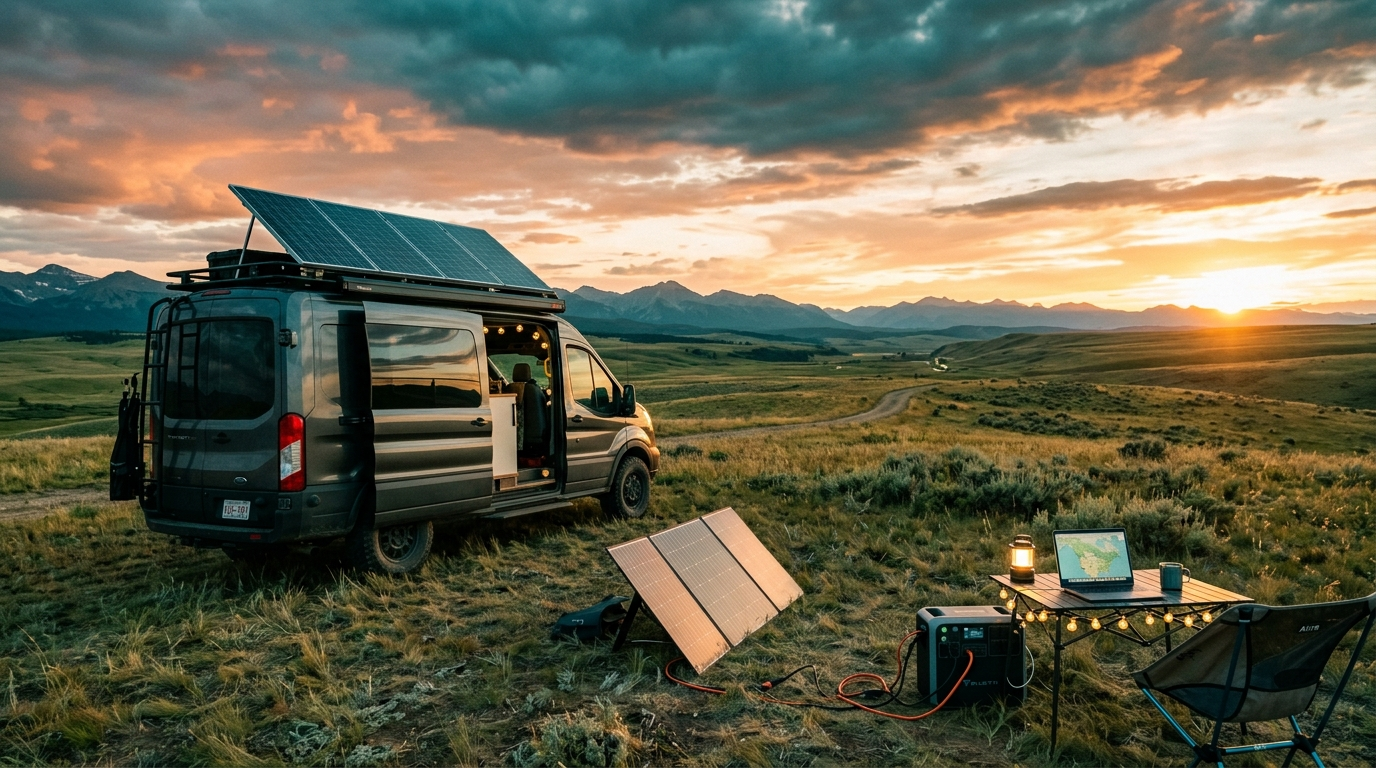
Quick Answer
Build the chain: solar panels → MPPT controller → LiFePO4 battery → 12V loads, then add a DC-DC charger from the alternator so driving refills the bank. Budget your watt-hours first (a two-person rig burns ~1,000 Wh/day), then size 300W of solar and 200Ah of lithium for indefinite off-grid camping in Alberta's 4–5 usable sun-hours.
Unlimited off-grid camping is not about carrying more power — it is about making power faster than you burn it. Get that balance right and the trip has no clock: the fridge stays cold, the lights stay on, the cameras stay charged, and the only reason to head home is the groceries. Here is how to design a solar system that actually balances, using real Alberta sun numbers instead of brochure fantasies.
Step 1: Know Your Burn Rate
Everything starts with a watt-hour budget. List every device, multiply its draw by hours used, and add it up. Here is a realistic two-person rig:
Your number will differ — a compressor fridge in July heat can double its figure, a Starlink adds 400–800 Wh — but the method is the whole game: measure, don’t guess. A $25 watt meter pays for itself on day one.
Step 2: The Four-Part Chain
Panels. Roof-mounted rigid panels work while you drive and while you forget about them; a portable folding panel chases the sun while you park in the shade like a sensible person. The killer combo is both: 200W on the roof, 100–200W portable. Real-world yield in an Alberta summer is roughly 4–5 usable sun-hours a day — so 300W of panel delivers about 1,200–1,500 Wh, conveniently above our budget.
Controller. Spend the extra on MPPT over PWM — it harvests 20–30% more from the same panels, which is like getting a free 75W panel, and it handles cold mornings (when panels overproduce) properly.
Battery. LiFePO4 ended the debate: half the weight of AGM, usable to nearly full depth of discharge, thousands of cycles. Size it to cover two cloudy days of your budget — for 1,050 Wh/day, that is a 200Ah (2,560 Wh) bank. All-in-one power stations bundle the controller, battery and inverter in one box and are the right answer for most people; a built-in dual-battery system is the right answer for permanent builds.
Loads. Run everything you can on 12V directly — inverters waste 10–15% making household power. A small 300–600W inverter covers laptop bricks and camera chargers; you do not need 2,000W unless you are running power tools or an espresso machine (no judgment).
Step 3: The Multiplier — Charge While Driving
A DC-DC charger from your alternator is the unsung hero of every serious build. Even a 25A unit dumps ~300Wh into your bank per hour of driving — and overlanding involves a lot of driving. Solar plus alternator means that in practice, arriving at camp with a full battery is the default, and solar merely holds the fort while you stay put.
Step 4: Install Details That Separate Good From Flaky
- Wire gauge matters more than brand. Undersized cable silently eats your harvest as heat. Follow the controller manufacturer’s gauge chart and keep runs short.
- Fuse everything within inches of the battery. A fuse is the cheapest fire suppression you will ever buy.
- Shade is a thief. Ten percent shade on one panel can halve its output. Park the rig where you like, walk the portable panel to the sun.
- Tilt in shoulder season. Flat panels lose serious yield in September Alberta sun angles; even a rough tilt recovers most of it.
- Check connections each trip. Corrugated roads undo screws. Five minutes with a screwdriver beats a dead fridge on day three.
Three Proven Recipes
| Setup | Components | Good For | Ballpark (CAD) |
|---|---|---|---|
| Weekender | 100W portable + 1kWh power station | Fridge + lights, 2–3 days | $1,100–$1,600 |
| The Sweet Spot | 200W roof + 100W portable, MPPT, 200Ah LiFePO4, DC-DC | Indefinite trips, two people | $2,800–$4,200 |
| Basecamp Pro | 400W roof + 200W portable, 300Ah+, 2kW inverter, Starlink budget | Work-from-trail, families | $5,500–$8,500 |
Frequently Asked Questions
How much solar do I need to run a 12V fridge while camping?
A compressor fridge uses roughly 500–700 Wh per day in summer. With 4–5 usable sun-hours, 150–200W of panel covers the fridge alone; 300W covers a whole two-person camp with margin.
Is MPPT really better than PWM for overlanding?
Yes — an MPPT controller harvests 20–30% more energy from the same panels, especially in cold mornings and partial sun. On any system over 100W the MPPT pays for itself quickly.
Can I charge my camp battery while driving?
Yes, with a DC-DC charger wired to the alternator. A 25–40A unit adds 300–500 Wh per driving hour, which is why solar plus DC-DC is the standard for serious overland builds.
LiFePO4 vs AGM — which battery is better for overlanding?
LiFePO4 wins on every axis that matters off-grid: half the weight, nearly full usable capacity, 3,000+ cycles, and faster charging. AGM only wins on upfront price and sub-freezing charging (solved by heated LiFePO4 models).
Gear up for the next one.
Rigs, trailers, tents, and trail-proven gear from the Trekkr community. Direct from seller, no commission.
Browse the Marketplace