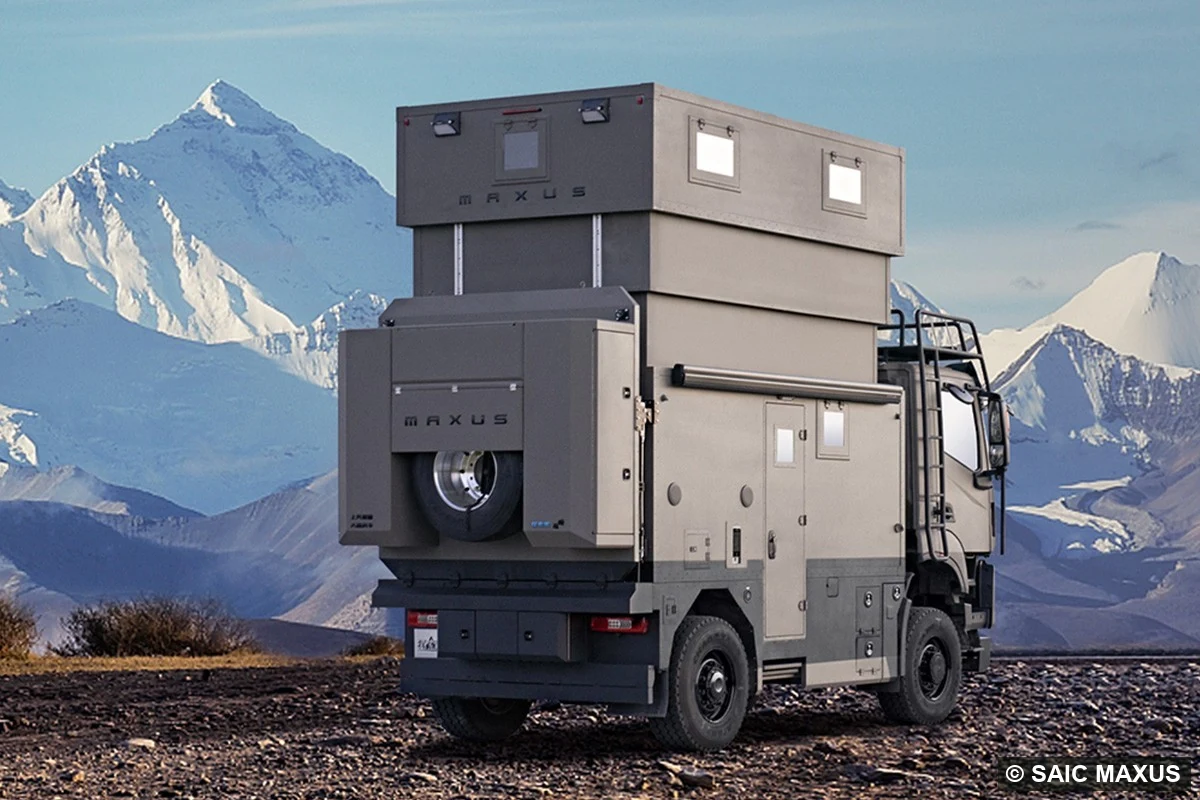
It parks like a truck and unfolds like an apartment. SAIC Maxus’ Explorer Everest raises a whole second storey once you’re in camp — dual projectors and a double bed upstairs, a 270° fold-out terrace off the tail, three diff locks and an Allison box underneath. It’s one of the wildest things being built on a truck chassis right now. So we went to the maker’s own page: who’s behind it, what’s really in it, what it costs, and the honest answer to whether one could ever sit in your driveway.
Picture pulling into a gravel pull-out above a glacial lake. The rig behind your cab looks like a serious expedition truck — boxy, high-clearance, riding on tires as wide as anything you’ve seen off-road. Then you push a button, and the roof keeps going up. And up. A whole second storey rises until you’re standing under what is, functionally, a small apartment on legs. That’s the pitch of the SAIC Maxus Explorer Everest (探索家·珠峰), and it is one of the strangest, most ambitious things anyone is currently building on a truck chassis.
We saw it doing the rounds on the RV press, then went straight to SAIC Maxus’ own product page to separate the marketing from the metal. Here’s what it actually is, who’s building it, what it really costs, and the honest answer to the question every North American asks first: can I get one?
A truck that becomes an apartment
The whole idea rests on one trick SAIC calls a “duplex two-storey pop-up”: on the move the Everest keeps a truck-like profile, and parked, the upper section lifts to create a two-level interior, joined by a 270° rear expanding terrace that folds out over the tail. Living space stacked, not stretched. It’s the opposite of a giant Class A that’s enormous everywhere, all the time — this thing is meant to be compact when it matters and cavernous when it doesn’t.
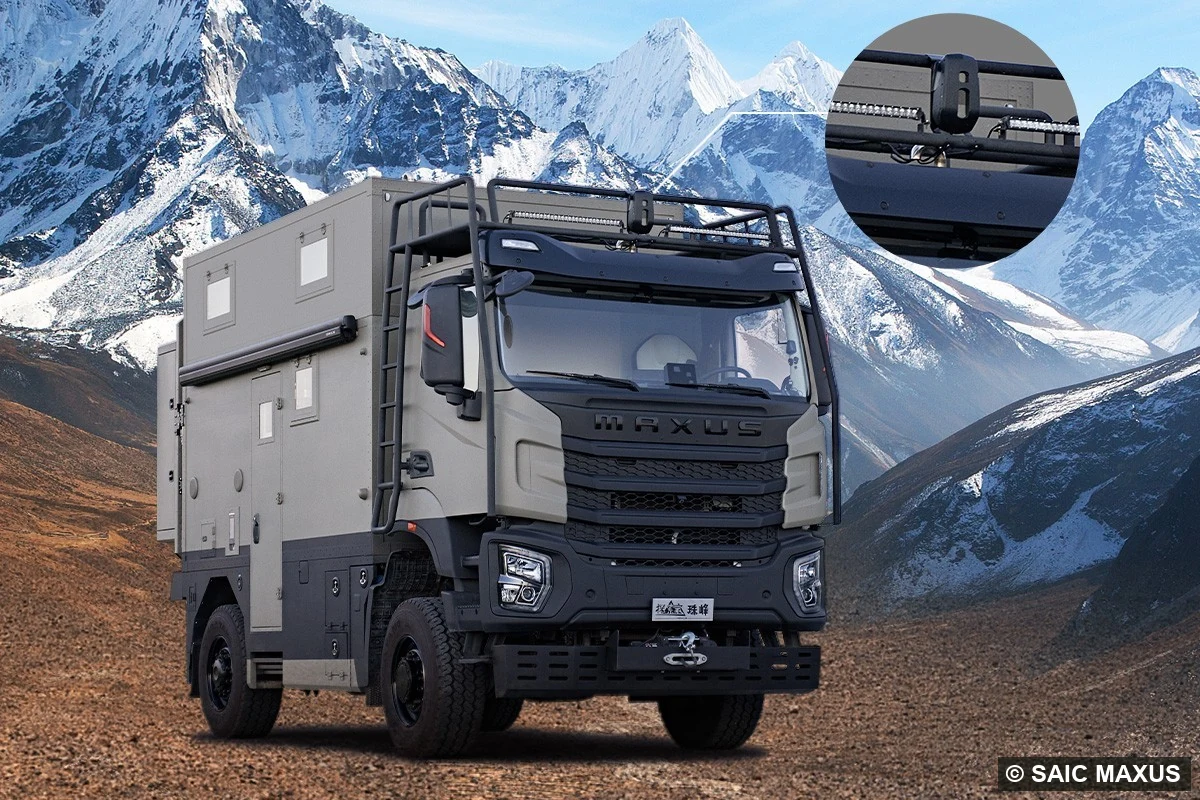
The styling backs up the promise. SAIC leans hard into a “mecha” look — blacked-out kit, rock-grey “explosion-proof armour” paint, steel front and rear bumpers, side skirts, and two 17,000-lb electric winches. This is a company that already builds pop-up, lift-roof and transforming RVs at every price point, from $33K budget campers up to this.
Who’s actually building this?
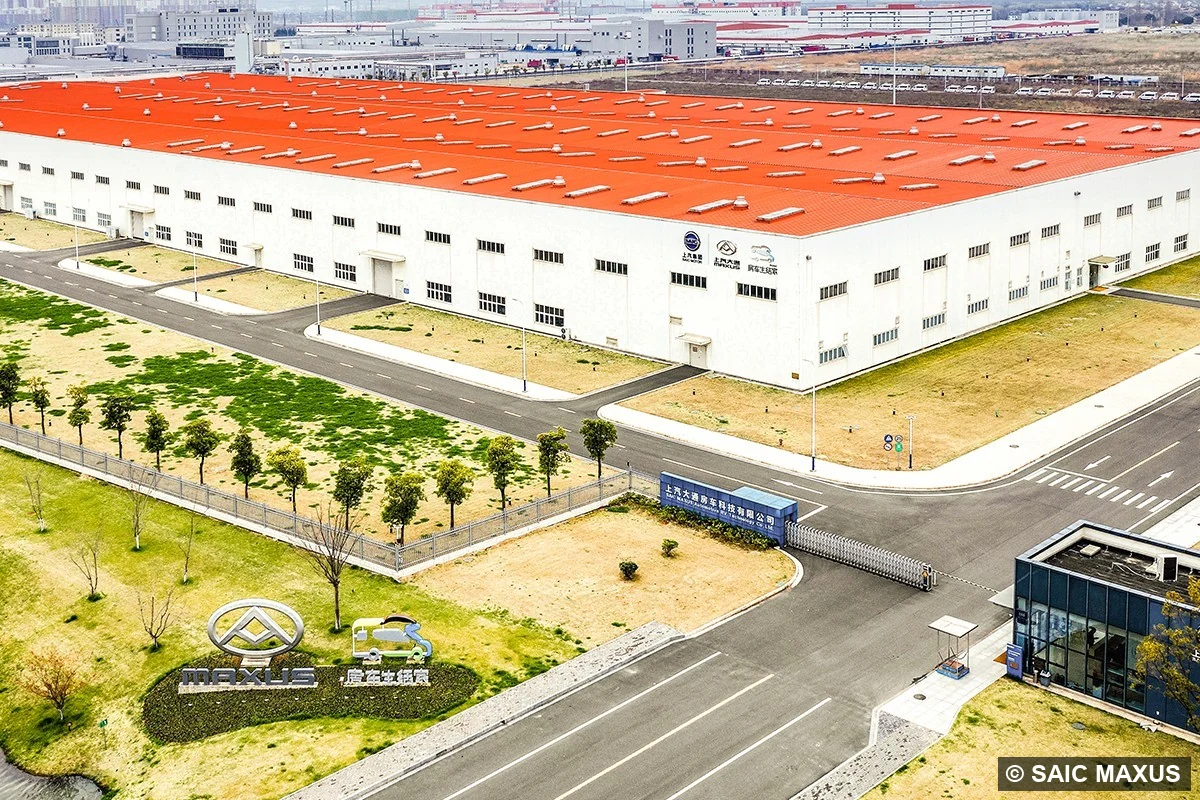
Not a plucky startup. SAIC Maxus is a brand of SAIC Motor — one of China’s largest, state-owned automakers, the same conglomerate that has built cars in joint ventures with GM and Volkswagen for decades. The Maxus name has real lineage, too: it traces back to LDV, the old British commercial-vehicle maker with roots in British Leyland. Today Maxus is the best-selling Chinese vehicle brand in the UK, Australia and New Zealand (often badged LDV), selling across more than 40 countries.
Crucially, they build these RVs as a factory product — not a coachbuilder’s one-off. SAIC quotes a full ownership backbone behind it: 11 brand-owned RV stores, 300-plus SAIC Maxus service centres and 50-plus RV repair stations, with a 15-minute response promise. That’s the difference between “cool render” and “an actual assembly line will build you one and stand behind it.”
What’s in the tower
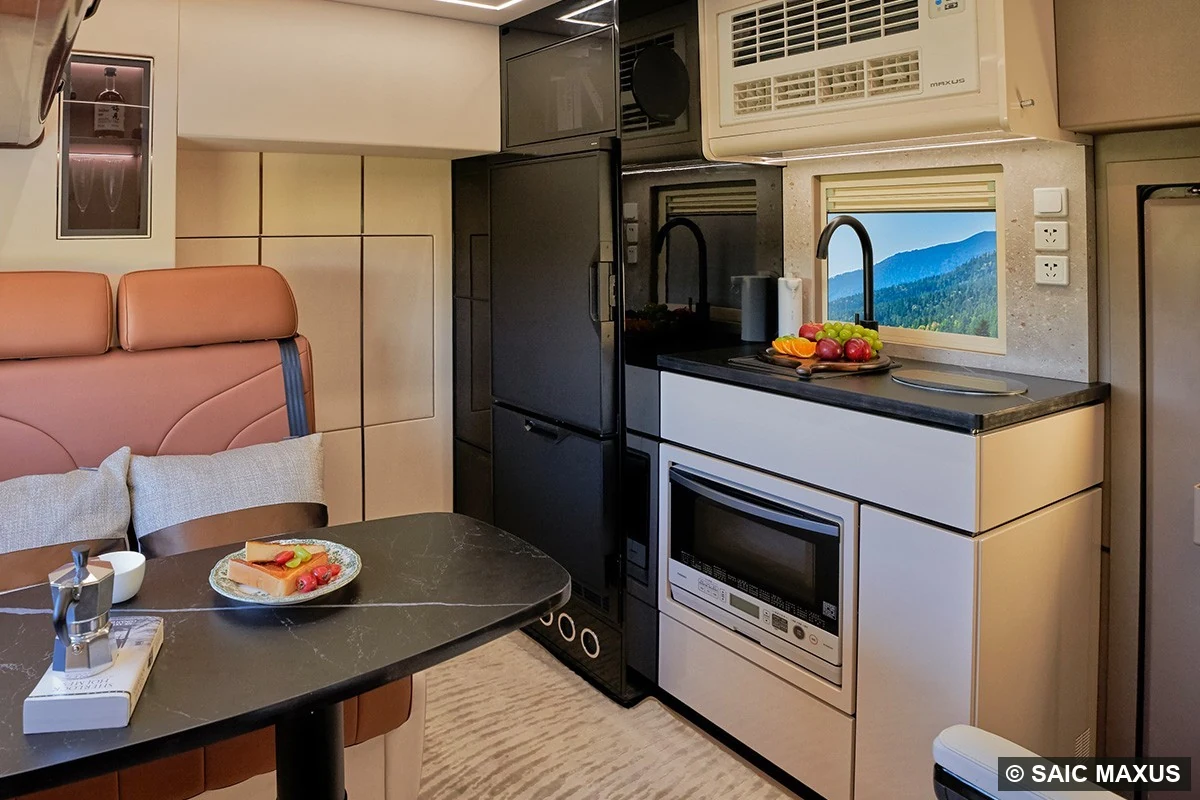
SAIC bills the Everest as a “luxury mobile villa,” and the upper level reads like a lounge, not a camper:
- First-class independent VIP seats, plus a two-person double bed and a three-person sofa on the second floor.
- Dual 50-inch projectors and a four-zone independent audio system — a proper theatre up top.
- A 174-litre fridge and a high-end microwave-steam-bake oven in the galley.
- Integrated electric under-floor heating beneath a wood floor — the detail that says they’re thinking about cold nights, not just show-floor photos.
On the smart side it runs an IoT “people + car + home” controller, with a mid-door lock that does TOF facial recognition and fingerprint entry. It’s a lot of house for something that’s supposed to climb a mountain road.
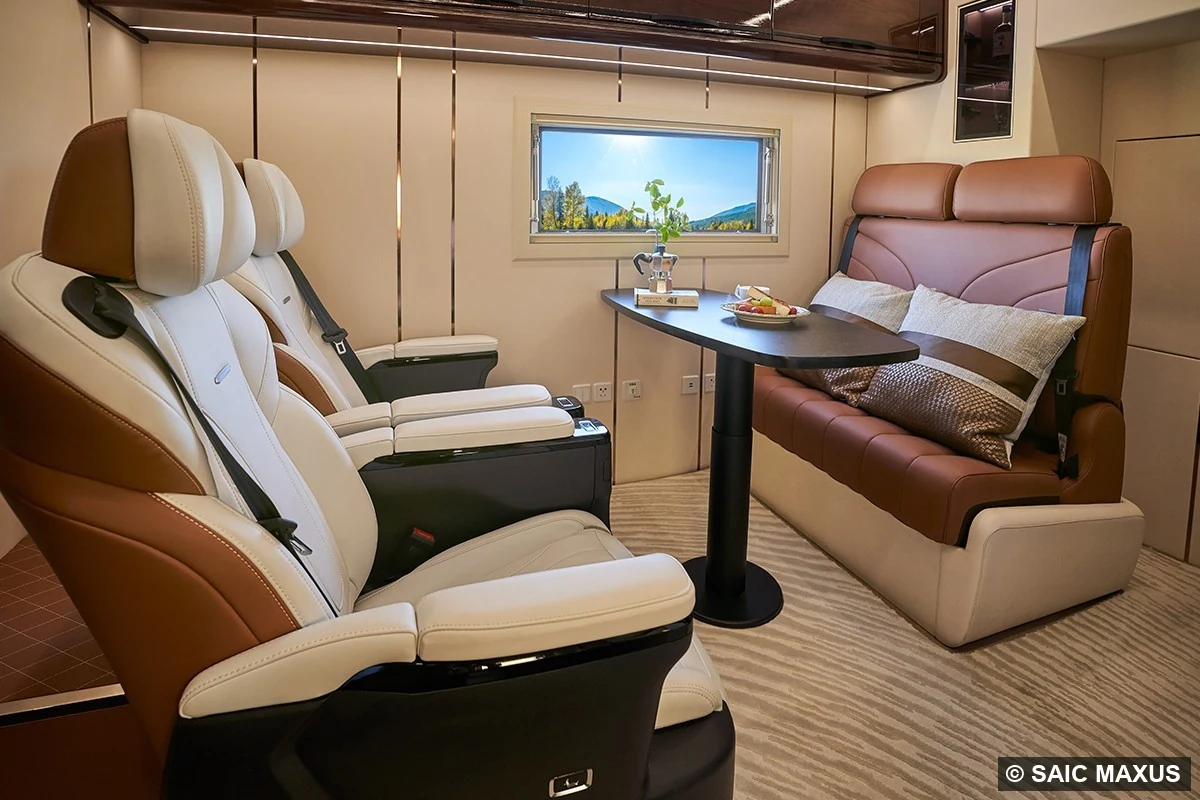
The galley and living quarters carry the same first-class-cabin theme — and the smartest layout touch is keeping the wet, muddy business of coming in from outside contained on the lower level, so the grime stays out of the living space above. Anyone who’s tracked half a trailhead into their rig understands exactly why.
The guts: a real diesel, an Allison box, three diff locks
Underneath the luxury talk, the running gear is legitimately serious:
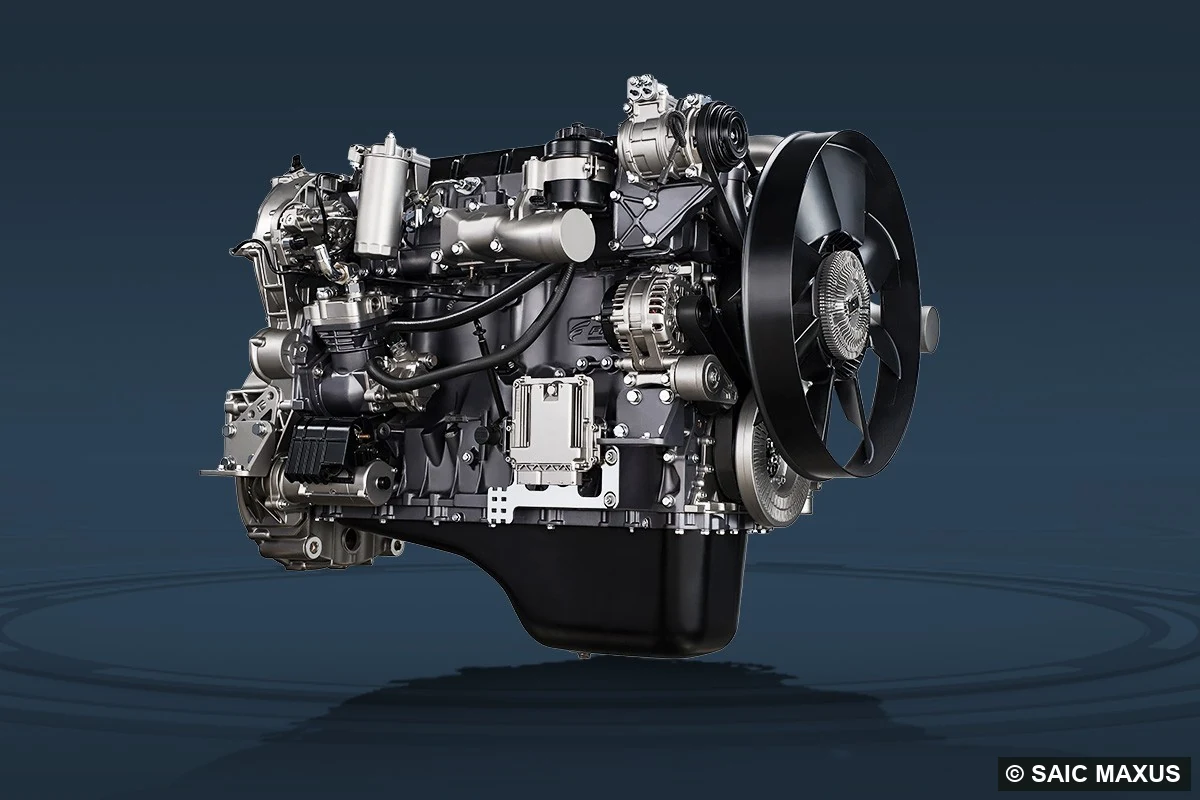
- A SAIC “Corso” C9 six-cylinder diesel making 243 kW (326 hp) and 1,400 N·m (1,033 lb-ft) of torque, paired with an Allison 3200P automatic.
- Full-time four-wheel drive with three differential locks, riding on 425-section extra-wide all-terrain tires and a three-point floating subframe.
- 1,000 km-plus of range, with an optional 600-litre fuel tank.
- A 29 kWh factory drive battery for the house systems, backed by a 3.5 kW parking generator with its own tank and exhaust, plus multiple charging modes.
- Food-grade water tanks and a 3M reverse-osmosis drinking-water filter — potable water straight from the tap.
- Safety kit you’d expect on a modern truck: ESC, ADAS driver assistance, four-wheel disc brakes, 360° camera, a six-way security system and height-limit collision warning.
What SAIC doesn’t publish, at least not on the spec page, are the numbers overlanders care about most: curb weight, GVWR, exact dimensions and ground clearance. For a rig whose whole concept is “small on the road,” those blanks are the ballgame — so file the off-road promise under “credible but unweighed” until someone puts one on a scale.
What it costs
Here’s the number, straight from SAIC’s own page: the Explorer Everest carries an official guide price from ¥2,880,000 RMB — roughly US$400,000 at today’s exchange. That’s not a grey-market guess; it’s the factory sticker. For context, Chinese makers also build two-storey campers on HOWO truck cabs for around US$33,000, so the Everest sits at the luxury summit of an enormously wide market.
The question everyone asks: can you get one in North America?
Short answer: realistically, no — not right now, and not easily. Here’s the honest breakdown, because this is where the dream meets the border.
SAIC Maxus does not sell in the United States or Canada, and its RV network is entirely domestic. A China-market RV can’t simply be shipped over and plated:
- The under-25-year wall (USA). Any vehicle less than 25 years old must comply with all applicable FMVSS safety standards and EPA emissions rules to be imported permanently. A rig built for China almost certainly doesn’t, and the model has to appear on NHTSA’s eligibility list — which a boutique Chinese RV won’t. The legitimate path is a Registered Importer bringing it into compliance: expensive, slow, and not guaranteed on a vehicle this unusual.
- The 25-year exemption. Once a vehicle is 25+ years old (from its build month), it’s exempt from FMVSS and EPA. For a 2025-ish Everest that means roughly 2050.
- Canada’s 15-year door. Canada is friendlier: vehicles 15 years and older can generally be imported outside the usual Transport Canada regime — around 2040 for this rig. Sooner than the US, still a long wait.
- Money on top. Even when eligible, expect duties (a motorhome is typically ~2.5%, but a truck camper can be dinged up to 25%), several thousand in ocean freight, weeks of transit, and a compliance bill on arrival.
So if you want a two-storey overlander in your driveway this year, the Everest isn’t it — and even if one landed, a proprietary SAIC diesel and Allison box are wonderful right up until something breaks in Nordegg with no dealer network on the continent. What the Everest is — a factory-built proof of concept from a serious automaker — is arguably more interesting than whether one specific unit can clear customs.
What it actually tells us
Strip away the border headache and the Everest is a window into something real: China’s RV industry is iterating faster, weirder and more ambitiously than most of the West. Two-storey pop-ups, lift-roof theatres, $33K budget campers and $400K luxury towers — all at once, backed by manufacturing muscle that can actually build the ideas and a service network to stand behind them.
Some of it is gimmick. But the good ideas — ground-floor mud-room layouts, genuinely compact-on-road footprints, big battery banks and potable-water filtration as standard — are exactly the kind of thing that shows up in everyone’s rigs a few years later. You don’t have to want an Everest to find it worth watching. We’ll be watching.
The best idea on the whole rig isn’t the dual-projector theatre upstairs — it’s the layout logic. Keep the mud, sand and meltwater on the ground floor, keep the living space clean above it. That’s a lesson worth stealing no matter what you drive.
Quick Answers
What is the SAIC Maxus Explorer Everest?
It is a factory-built heavy-duty overland RV from Chinese automaker SAIC Maxus (Chinese name 探索家·珠峰) that expands vertically once parked, creating a two-storey interior with a 270-degree fold-out rear terrace. The upper level holds first-class VIP seats, a double bed, a three-person sofa, dual 50-inch projectors, four-zone audio, a 174-litre fridge and a microwave-steam-bake oven, with electric under-floor heating throughout.
Who is SAIC Maxus?
SAIC Maxus is a brand of SAIC Motor, one of China’s largest state-owned automakers, known for joint ventures with GM and Volkswagen. The Maxus name descends from the old British LDV commercial-vehicle marque. Maxus is the best-selling Chinese vehicle brand in the UK, Australia and New Zealand and builds the Everest as a factory product backed by 11 brand RV stores and more than 300 service centres in China.
Can you buy the Explorer Everest in North America?
Not readily. SAIC Maxus does not sell in the US or Canada, and a Chinese-market RV under 25 years old must meet all US FMVSS safety and EPA emissions standards to be imported — which it does not out of the box. The US 25-year exemption would apply around 2050, and Canada’s 15-year rule around 2040. A Registered Importer is the only near-term path, and it is expensive and not guaranteed.
How much does the Explorer Everest cost?
SAIC Maxus lists an official guide price from ¥2,880,000 RMB, which is roughly US$400,000 at current exchange rates. That is the factory price in China. For context, Chinese manufacturers also build far cheaper two-storey campers — some around US$33,000 on HOWO truck cabs — so the Everest sits at the luxury top of a very wide range.
Is it any good for real overlanding?
The running gear is serious — a SAIC Corso C9 six-cylinder diesel making 326 hp and 1,033 lb-ft, an Allison 3200P automatic, full-time four-wheel drive with three differential locks, 425-section all-terrain tires, a 29 kWh house battery, a 3.5 kW generator and reverse-osmosis drinking water. But SAIC has not published curb weight, GVWR, dimensions or clearance, which are exactly the numbers that decide whether a two-storey box can handle real backcountry roads. Until one is weighed and measured, the off-road capability is credible but unproven.
Trusted Sources
Field-tested by the Trekkr community. Trail conditions change — always check current advisories before you roll out.
Your Rig Belongs on This Page
Drop your best shots and the story of your build. Every week we feature community rigs — free, always.
Trekkr.life shares field notes from the overlanding community for general information only. Backcountry travel carries real risk — verify routes, weather, fire bans, and regulations with official sources before you go. Gear opinions are our own and never sponsored.